TechnologyOctober 12, 2026
Why Lettuce Leaf Tips Burn
Even when nutrients are plentiful, the tips of the inner leaves of lettuce can turn brown and dry out. This is tipburn, which occurs when calcium fails to reach the leaf tips. We have put together the causes, and the reasons why indoor farms keep a close watch on airflow and nutrient solution.
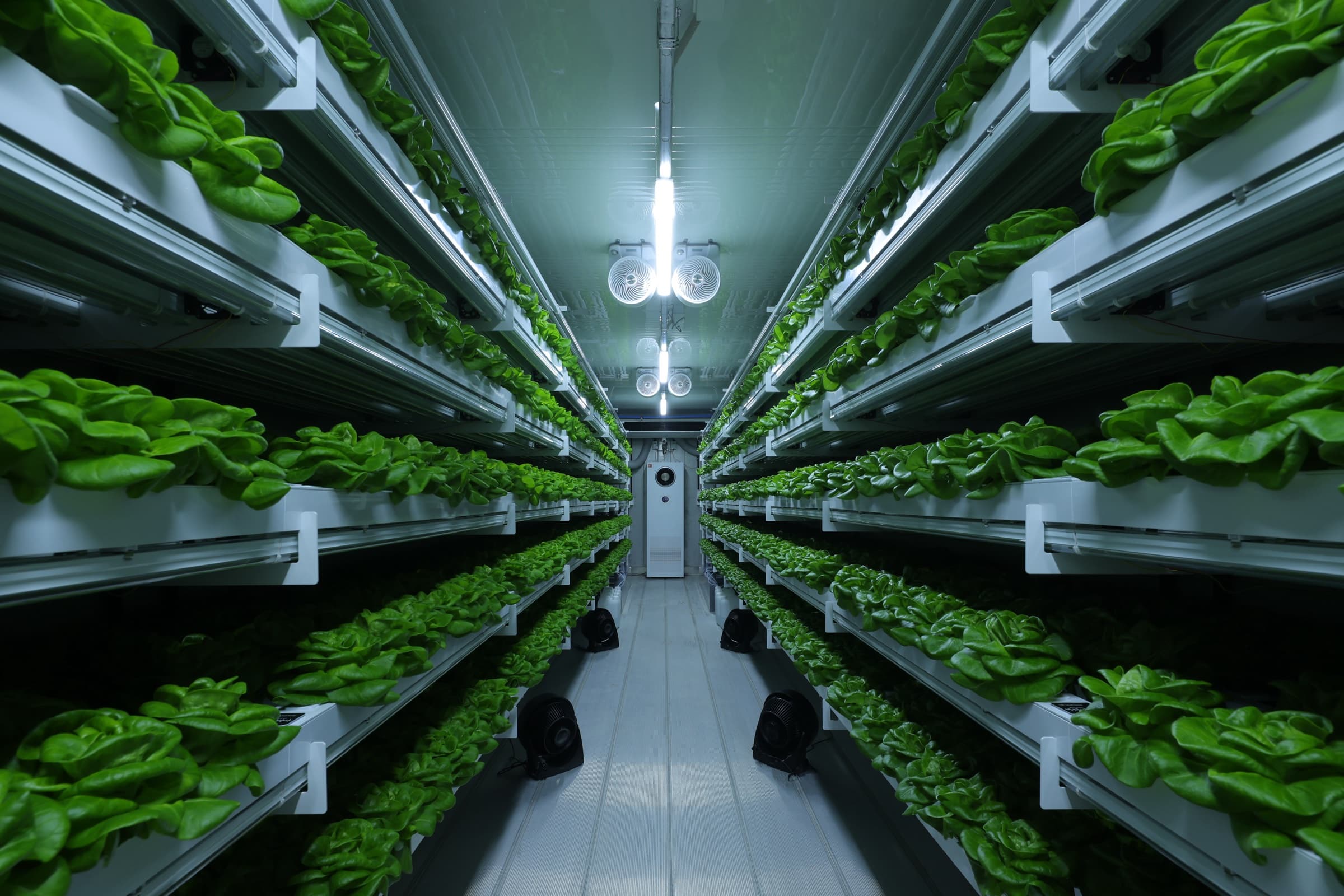
When growing lettuce, the tips of young leaves emerging from the center sometimes turn brown and dry out. It is not a disease that has spread, nor is it insect damage. It is a physiological disorder called tipburn. When the leaf tips dry out, market value drops sharply. Wherever leafy greens are grown, whether in a greenhouse or an indoor farm, it is a constant concern.
Calcium Moves With Water
The cause is calcium. Yet it occurs even when there is plenty of calcium in the nutrient solution. That is because the calcium does not reach the leaf tips.
Plants release the water drawn up by their roots from their leaves as water vapor. This is called transpiration. Calcium rides this flow of water upward. It arrives readily in the large outer leaves, where a great deal of water escapes, and arrives less in leaves from which little water escapes.
Tipburn is commonly explained this way. The fastest-growing young leaves need the most calcium, yet because less water escapes from them, they receive the least calcium.
The inner leaves are exactly such a place. A review paper published this March in the journal Frontiers in Horticulture by researchers at the University of Turin in Italy and others explains that tipburn usually occurs as a layer of stagnant air forms around the newly growing inner leaves. When air sits still, transpiration decreases, and when transpiration decreases, less calcium arrives.
So We Look at Airflow
The same paper cites airflow as an environmental factor that is "important yet often underestimated." When air movement clears away the stagnant layer of air around the leaves, transpiration increases and calcium is distributed more evenly within the plant. At the same time, it introduces research showing that when airflow is excessively strong, growth actually declined. Stronger is not better; there is an appropriate range.
Humidity works by the same principle. The paper summarizes that when humidity is excessively high, transpiration is blocked, so nutrients such as calcium are transported less and the risk of tipburn rises. Temperature and light are related as well. The common explanation is that the faster a plant grows, the more calcium it needs.
This is precisely why the problem is trickier in indoor farms. When shelves are stacked in multiple tiers, it is easy for spots to form where air does not flow evenly, and the better light and temperature are tuned, the faster lettuce grows. The conditions for good growth are also the conditions in which tipburn readily occurs.
We Look at the Nutrient Solution Too
It is not only a matter of air. In a press release this July, the Rural Development Administration stated that in hydroponics where nutrient solution is reused, ion balance must be examined carefully during the summer. In trials conducted at lettuce hydroponic sites from May through August, yields fell by about 50% when the nutrient solution was reused for two or more growing cycles.
The reason lies in the fact that plants do not take up nutrients evenly. Nitrate nitrogen and potassium, which are absorbed quickly, decreased, while calcium, magnesium, and sulfur continued to accumulate in the solution. Electrical conductivity (EC), which indicates overall concentration, stayed the same, but the composition within it changed. The Rural Development Administration noted that when the ion balance in the nutrient solution breaks down, tipburn can appear in leafy greens, and advised checking the values for individual ions rather than matching electrical conductivity alone.
A Single Number Will Not Show It
Tipburn does not disappear by getting one value right. Temperature, humidity, light, airflow, and the composition of the nutrient solution must all align, and when one of them goes astray, it shows up first in the youngest leaves.
This is also why N.THING controls the cultivation environment as a whole rather than piece by piece. N.THING creates an environment in which light, temperature, humidity, carbon dioxide, and nutrients are all controlled, and gathers temperature, humidity, carbon dioxide, illuminance, and nutrient solution values to view on a single screen. The data produced in one growing cycle is used to set the parameters for the next. Only then can the cause of a problem such as burning leaf tips be narrowed down.
You can see N.THING's farms and cultivation technology on the Solutions and Technology pages.